
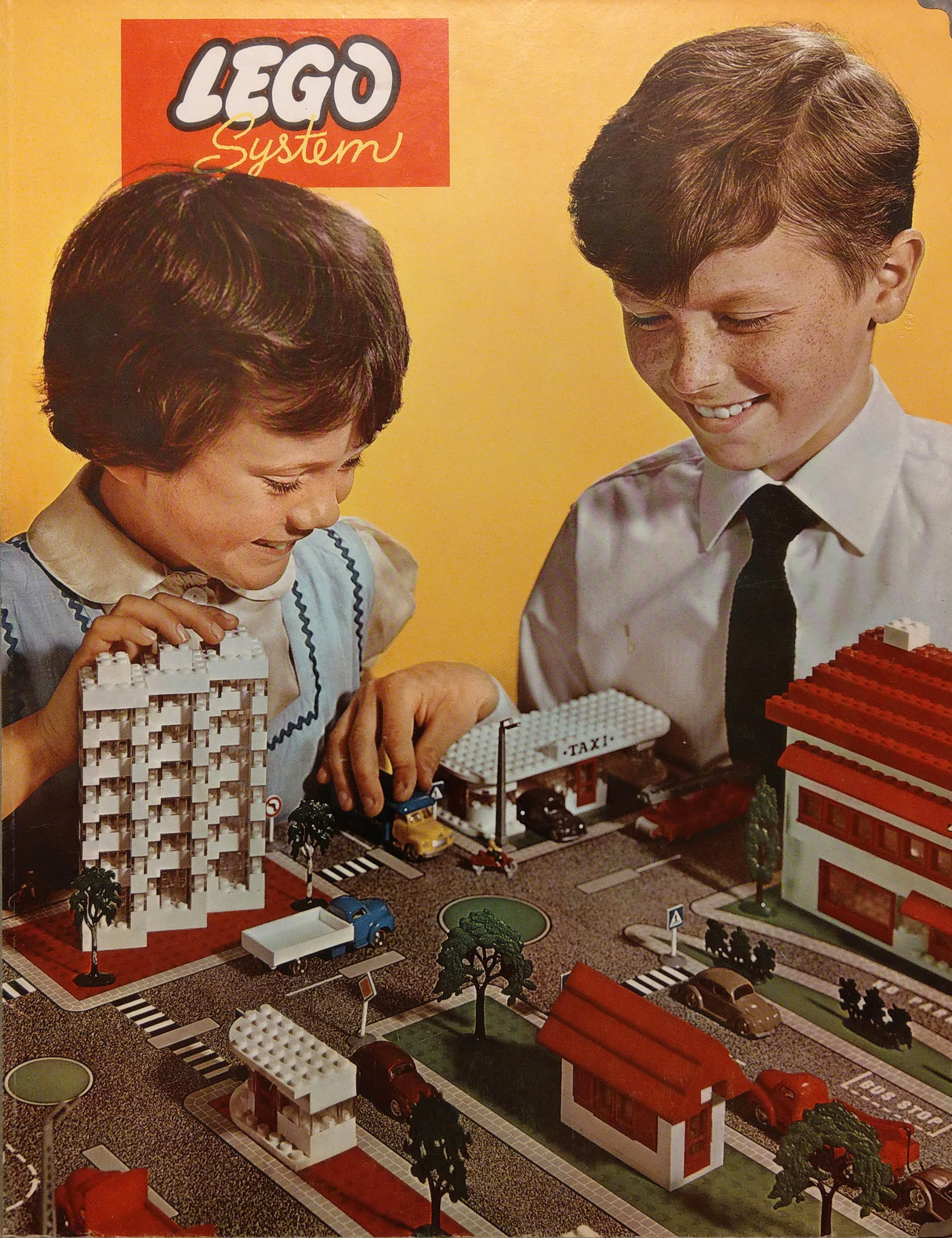
LEGO Town Plan
1955
The LEGO Town Plan was a foundational "System in Play" concept launched in 1955, designed to provide a context for children to arrange their LEGO buildings and vehicles into a complete urban setting. It was centered around a printed mat (initially plastic cloth, later Masonite) showing a network of streets and building plots.
Overview of the Town Plan System
The Town Plan was developed in collaboration with the Danish Council for Road Safety, aiming to teach children about traffic behavior.
Road Layouts: The core component was the printed town board, which featured a stylized network of streets, parking spaces, and areas for buildings. Unlike modern baseplates, these original boards were mostly flat with printed roads, not studded.
Scale: The early sets were based on a smaller 1:87 (HO) scale, not the later minifigure scale.
Vehicles and Accessories: The system included small, non-brick-built plastic cars and lorries, as well as miniature police officers (also non-brick-built) to direct traffic.
Buildings: Children could use their standard LEGO bricks to build houses, shops, a gas station, or a town hall on the designated plots on the map.
Special Pieces: The Town Plan introduced some specialized elements, such as garage baseplates with a slope that allowed a car to roll out when the door was opened, and clear showcase bricks for car showrooms.
Legacy
The original Town Plan theme ran until 1966. The concept was a direct inspiration for the later, more extensive LEGOLAND Town theme introduced in 1978, which used studded baseplates with roads to integrate buildings more seamlessly into the system.
In 2008, LEGO released a special, modern tribute set for the 50th anniversary of the LEGO brick: the LEGO 10184 Town Plan. This set recreated the aesthetic of the 1950s town but used modern bricks and was built to the scale of the contemporary minifigure.